
 Brochure

G+3 vs G+4 in Bangalore: The ₹30 Lakh Question Most Plot Owners Get Wrong
Why This Decision Matters More Than Most People Realise
You've already bought the plot. You're in the planning stage. The architect has shown you two options — G+3 and G+4 and told you the fourth floor adds roughly 20–25 lakhs. So you're leaning towards building it. More floors, more rental income, better ROI.
But here's what the architect probably didn't tell you: In Bangalore, a large proportion of plots cannot legally support G+4 at all. Not because of the budget. Because of FAR entitlement, road width restrictions, and setback rules under the Greater Bengaluru Authority (GBA) framework that came into full effect in 2025. And if your plot does qualify, the actual cost of going from G+3 to G+4 is usually 28–38 lakhs, not 20–25 lakhs, once you account for structural redesign, lift requirements, and fire compliance.
This guide does one thing: it gives you the exact criteria to determine whether G+4 makes legal, financial, and practical sense on your specific plot in Bangalore, before you spend a rupee on construction.
| Metric | Value |
|---|---|
| Bangalore plots that legally cannot reach G+4 due to plot size or road width | ~60% |
| True extra cost of going G+3 to G+4 on a standard 40x60 plot | 28–38L |
| Minimum road width required under GBA for any G+4 construction | 9 m |
| Payback period for a well-planned fourth floor from rental income | 6–8 yr |
FAR and FSI Rules in Bangalore Under GBA (2025–26)
Floor Area Ratio (FAR) also called Floor Space Index (FSI) is the single most important number governing how much you can build on your plot. It is calculated as:
Formula: FAR = Total Built-up Area / Plot Area
A FAR of 2.0 on a 2,400 sq ft (40x60) plot means you can build a maximum of 4,800 sq ft of total floor area across all floors combined.
Under the GBA's 2025–26 regulations, residential FAR in Bangalore is structured in three tiers:
| Plot Size | Base FAR | Max Premium FAR | Typical Max Floors | G+4 Possible? |
|---|---|---|---|---|
| Up to 150 sq.m (e.g. 30x40, 30x50) | 1.75 | Not applicable | G+2 to G+3 | NO |
| 150–250 sq.m (e.g. 40x50) | 2.00 | Up to +40% on 9m+ road | G+3 to G+3 (stilt) | MARGINAL |
| 250–500 sq.m (e.g. 40x60, 50x60) | 2.25 | Up to +40% on 9m+ road | G+3 to G+4 | YES |
| Above 500 sq.m | 2.5–3.0 | Up to +40% + 20% TDR on wide roads | G+4 and above | YES |
The key point: 30x40 plots (1,200 sq ft / 111 sq.m) do not qualify for G+4 under standard GBA rules. They are capped at 12 metres excluding stilt, which allows G+2 with stilt, or G+3 in some configurations. This is the most common plot size in Bangalore's older layouts.
Premium FAR: Can You Buy Your Way to G+4?
Since February 2025, Karnataka has fully operationalised its Premium FAR guidelines. This allows developers and homeowners on qualifying plots to purchase additional FAR up to 40% above base, by paying approximately 28% of the guidance value of the extra built-up area to the government.
Important Caveat: Premium FAR is not a workaround for every plot. A minimum road width of 9 metres is a strict mandatory baseline for any premium FAR allocation across all zones in Bangalore. Without a 9m+ road, premium FAR cannot be applied regardless of your plot size or budget. Additionally, premium FAR charges can range from 15 to 40+ lakhs depending on your plot's guidance value.
The Road Width Rule That Kills Most G+4 Plans
Of all the rules governing G+4 construction in Bangalore, this is the one that catches the most plot owners off-guard, because it has nothing to do with your plot size or your budget:
If the road next to your plot is less than 9 metres wide, you cannot build a G+4 building in Bangalore. That's the rule, no shortcuts, no exceptions.
Under GBA's unified development norms, the 9-metre road width threshold is a hard requirement for buildings exceeding 15 metres in total height. A standard G+4 residential building reaches approximately 17–18 metres above this threshold, even without a stilt floor. This means the road in front of your plot is as important as the plot itself.
Why This Rule Eliminates So Many Bangalore Plots
Bangalore's residential fabric is a patchwork of different eras and development standards. Here's the reality across different layout types:
| Layout Type / Era | Typical Road Width | G+4 Possible? |
|---|---|---|
| Old BDA layouts (pre-2000) | 6–9 m (varies) | CHECK INDIVIDUALLY |
| Interior BBMP wards (older) | 3–6 m | NO |
| Revenue layout / panchayat areas | 3–7.5 m | MOSTLY NO |
| New BDA / BMRDA layouts (post-2010) | 9–18 m | YES (if plot qualifies) |
| IT corridor areas (Whitefield, ORR, Sarjapur) | 9–30 m (arterial) | YES (check plot size) |
| North Bangalore (Devanahalli, Yelahanka) | 9–12 m (planned zones) | YES in planned zones |
How to Check Your Road Width: The road width abutting your plot is recorded in your BDA / BBMP layout plan and can be verified through the GBA's digital portal (under construction as of mid-2025) or at your local BBMP ward office. Your architect can also obtain this from the approved layout plan. Always check this before commissioning a G+4 design, not after.
What G+3 and G+4 Actually Look Like on Your Plot
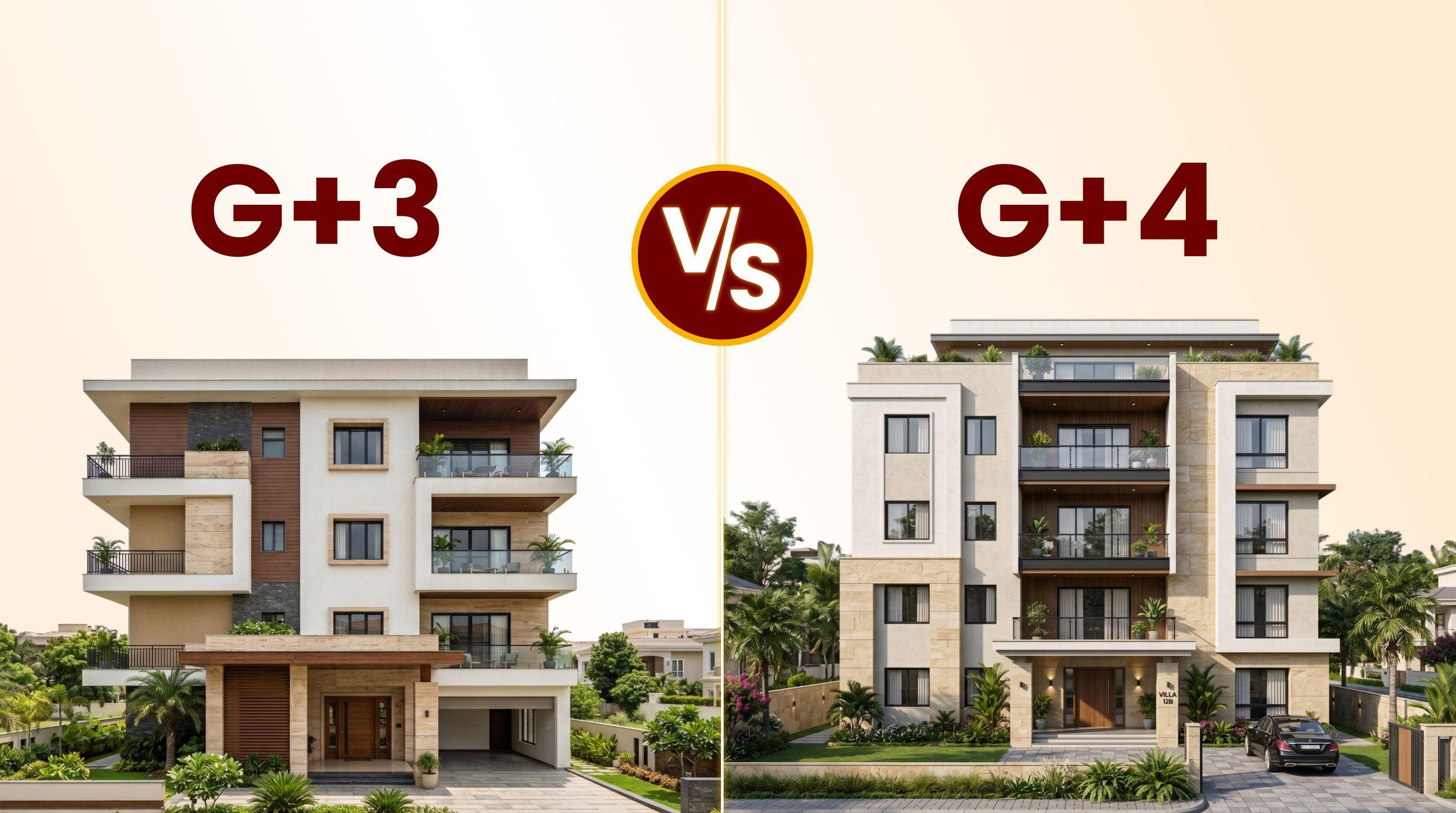
Below is how a G+3 and a G+4 building compare on a standard 40x60 Bangalore plot, the most common plot size in areas like Whitefield, Sarjapur Road, and Hebbal that typically does qualify for G+4.
Option A — G+3 (Standard configuration, 40x60 plot)
| Floor | Use |
|---|---|
| G+3 | 2 or 3 rental units |
| G+2 | 2 or 3 rental units |
| G+1 | 2 or 3 rental units |
| GF | Ground floor: owner unit or rental |
| STL | Stilt: parking (optional) |
Total: ~4,800–5,400 sq ft | Height: 12–15 m
Option B — G+4 (Extended configuration, 40x60 plot)
| Floor | Use |
|---|---|
| G+4 | 2–3 units (extra cost) |
| G+3 | 2 or 3 rental units |
| G+2 | 2 or 3 rental units |
| G+1 | 2 or 3 rental units |
| GF | Ground floor: owner unit or rental |
Total: ~6,000–6,600 sq ft | Height: 17–18 m (lift required)
The visual difference is one floor. The cost, approval, and structural difference is anything but simple, which is what the next three sections break down in detail.
The Real Cost Difference Between G+3 and G+4
The most common mistake in the G+3 vs G+4 decision is treating the fourth floor as a simple addition. It isn't. When you go from G+3 to G+4, you don't just add one floor's worth of material and labour — you trigger a chain of structural and compliance requirements that affect every floor below.
Here is a realistic cost comparison for a standard 40x60 plot in Bangalore, built at mid-range specifications (2,200–2,500 per sq ft for structure and basic finishes):
| Cost Item | G+3 Build | G+4 Build |
|---|---|---|
| Structure (RCC, columns, slabs) | 42–48 L | 54–62 L (heavier) |
| Finishing (all floors) | 28–34 L | 35–42 L |
| Electrical & plumbing | 8–10 L | 10–13 L |
| Staircase, railings, doors | 5–7 L | 6–9 L |
| Building plan approval | 3–5 L | 5–9 L |
| Architect + structural engineer | 4–6 L | 6–9 L |
| Lift shaft + unit | Not required | 10–15 L |
| Total Project Cost | 90 L – 1.1 Cr | 1.25 – 1.6 Cr |
The Real Extra Cost: The incremental cost of G+4 over G+3, including structural upgrade, extra floor finishing, lift, and approval uplift is typically 28–42 lakhs on a standard 40x60 plot. This is significantly higher than the 18–22 lakhs quoted for "just one extra floor" because it accounts for the structural redesign that affects the entire building, not just the fourth floor in isolation.
The Structural Jump: What Changes When You Add One Floor
Most homeowners think of adding a floor like adding another layer to a cake. Structurally, it's more like redesigning the recipe from the bottom up. Here's why.
1. Foundation Load
Every additional floor adds dead load and live load to the foundation. A G+4 building carries approximately 25–30% more cumulative load than a G+3 building of the same footprint. This means the foundation design, depth, width, and reinforcement of footings must be recalculated from scratch. On Bangalore's typically mixed soil (laterite overlying variable bearing capacity), this often means going deeper, which increases excavation and concrete volume significantly.
2. Column Sizing
Columns in a G+4 building must carry greater cumulative load. This means column cross-sections are typically larger throughout the entire structure, not just on the fourth floor. A column designed for G+3 at 230x350mm may need to be 300x450mm for G+4. This affects every floor, every room layout, and every aesthetic decision you've already made.
3. Slab and Beam Design
The increased column sizes change beam spans and slab depths at every level. Your structural engineer must re-run the entire frame analysis — this is why structural engineering fees go up meaningfully for G+4, and why you cannot simply hand your G+3 drawings to a contractor and say "add one more floor."
4. Lift Requirement
A building that reaches or exceeds 15 metres requires a lift under current BBMP/GBA norms. A stilt + G+4 building is approximately 17–18 metres. The lift shaft must run from the stilt level to the fourth floor, consuming 25–35 sq ft of space on every single floor. The lift unit itself (a basic domestic lift) costs 8–12 lakhs, plus 2–3 lakhs for the machine room and shaft construction.
A Note on Structural Engineers: In Bangalore, many residential buildings are designed by architects without adequate structural engineering review. For G+3, this is already a risk. For G+4, it is a serious one. Any G+4 building must be designed by a licensed structural engineer registered with GBA/BBMP, not adapted from a G+3 plan. Indecimal commissions independent structural analysis for every multi-storey project, regardless of height.
ROI Reality: Does G+4 Pay Back the Extra 30 Lakhs?
This is ultimately what the decision comes down to. The fourth floor adds approximately 28–42 lakhs in cost. Does the additional rental income from that floor recover the investment in a reasonable time?
Let's run the numbers on a concrete example. A G+4 building on a 40x60 plot near Sarjapur Road, a solid IT corridor market with three 2BHK units on the fourth floor:
| Metric | G+3 Building | G+4 Building |
|---|---|---|
| Total floors (incl. stilt) | Stilt + G+3 | Stilt + G+4 |
| Rentable units (typical) | 9–12 units | 12–15 units |
| Monthly rental income | 1.4–1.8 L/month | 1.8–2.3 L/month |
| Incremental income from G+4 | — | 35,000–55,000/month |
| Annual incremental income | — | 4.2–6.6 L/year |
| Extra construction cost | — | 28–42 L additional |
| Payback period | — | 5–9 years |
| Total construction cost | 90 L – 1.1 Cr | 1.25 – 1.6 Cr |
| Annual ROI on total investment | 18–22% | 16–20% |
| 10-year income | ~1.7–2.2 Cr | ~2.2–2.8 Cr |
| Metric | Value |
|---|---|
| Extra income per month from G+4 floor | 40–55K |
| Typical payback period for extra cost | 6–8 yr |
| Additional 10-year income from G+4 | 50–60L |
The data shows that G+4, where it qualifies, does generate a positive long-term return, but the annual ROI percentage is slightly lower than G+3 on total capital employed, because the incremental cost is high relative to the incremental income. The case for G+4 is strongest when you're optimising for total 10-year wealth rather than first-year yield percentage.
Key Insight: G+4 does not dramatically improve ROI. It improves total income. If your goal is the highest return on investment, a well-designed G+3 with smart room mix frequently outperforms a generic G+4. The extra 35 lakhs invested in better room design, premium finishes, and professional property management on a G+3 can yield more than spending it on a fourth floor.
Which Bangalore Plots Actually Qualify and Benefit From G+4
Based on GBA norms and real-market data from Bangalore's active construction corridors, here is a straightforward breakdown of where G+4 works and where it doesn't:
| Plot & Location Type | Plot Size | Road Width | G+4 Verdict | Best Decision |
|---|---|---|---|---|
| 30x40 plot, interior layout | 111 sq.m | Typically 6–7.5m | NO | Build G+3 with stilt. Maximise room mix. |
| 30x50 plot, BDA layout | 139 sq.m | Typically 7.5–9m | MARGINAL | Check road width. If <9m, stick to G+3. |
| 40x60 plot, IT corridor area | 223 sq.m | 9–18m (planned) | YES | G+4 viable if income plan justifies cost. |
| 50x80 plot, North Bangalore | 372 sq.m | 9–12m | YES | G+4 recommended if building for rental. |
| 40x60 plot, old BBMP ward | 223 sq.m | 4–6m (narrow lanes) | NO | G+3 maximum. Check with BBMP for exact limit. |
| 60x90+ plot, Devanahalli / Airport | 502 sq.m+ | 12–24m (arterial) | YES | G+4 and premium FAR both viable. |
The single most reliable pre-check: verify your road width before commissioning any design. If your road is under 9 metres, the G+4 question is answered and you can direct all your planning energy toward getting the maximum out of a well-designed G+3 instead.
The G+3 vs G+4 Decision Framework
After working through FAR limits, road widths, structural costs, and ROI data, the decision framework simplifies to five questions. Answer these in order:
1. Does your plot size exceed 250 sq.m?
Plots below 250 sq.m (including all 30x40, 20x40, and most 30x50 sites) are almost certainly capped at G+3 under base FAR. If no, stop here and plan G+3. If yes, proceed to question 2.
2. Is the abutting road 9 metres or wider?
Measure or verify from the approved layout plan. If the road is under 9 metres, G+4 is not permissible under GBA rules regardless of plot size. If 9m+, proceed to question 3.
3. Does your FAR entitlement support G+4?
Calculate available built-up area: plot area x FAR. If the resulting number accommodates a meaningful fourth floor (at least 800–1,000 sq ft of usable space after setbacks), the FAR supports G+4.
4. Does your rental income plan recover the extra 28–40L in under 10 years?
If the fourth floor will generate 35,000–50,000/month in additional rental income, payback occurs in 6–10 years, typically worth building. If the rental market doesn't support that income, G+3 is the better financial decision.
5. Are you prepared for the lift, fire NOC, and extended approval process?
G+4 requires a lift (10–15L), additional fire safety measures, and a more complex approval process that typically adds 2–4 months. If timeline or budget is constrained, G+3 delivers the income without this complexity.
The Summary Decision
| Build G+3 if | Build G+4 if |
|---|---|
| Plot is below 250 sq.m (any 30×40, 30×50) | Plot is 40×60 or larger (above 250 sq.m) |
| Road width is under 9 metres | Road is 9 metres or wider (verified) |
| Rental market is medium-density (students, lower rents) | You're in an IT corridor with strong rental demand |
| Budget is under ₹1.1 crore | The fourth floor generates ₹40,000+/month incremental |
| Timeline is under 18 months | You're optimising for 10-year total wealth, not first-year yield |
| You want the highest ROI on investment, not maximum total income | You're prepared for the lift, extra approvals, and higher upfront cost |
| You're in an older layout with narrow internal roads | The structural design is done properly from scratch (not adapted from G+3) |
Approvals and Timeline for G+4 in Bangalore
Under the GBA's single-window system, building plan approvals for G+4 buildings are more complex than for G+3, not just in timeline, but in the documents and clearances required.
What G+4 Approval Requires That G+3 Doesn't
| Approval Requirement | G+3 | G+4 |
|---|---|---|
| Licensed architect drawings | Required | Required |
| Structural engineer certification | Required | Required (more rigorous) |
| Soil test report | Recommended | Mandatory |
| Fire NOC from KFES | Not required | Mandatory (building >15m) |
| Lift approval | Not required | Mandatory |
| Premium FAR charge (if beyond base) | Not applicable | Depends on FAR used |
| Typical plan approval timeline | 4–8 weeks (GBA portal) | 8–16 weeks (multiple clearances) |
| Approval cost estimate | 3–5 lakhs | 5–9 lakhs |
GBA Transition Note: As of mid-2025, the GBA's single-window approval portal is partially operational. Many approvals are still transitioning from legacy BBMP and BDA processes. For G+4 projects, it is advisable to work with a licensed architect who actively tracks GBA notifications, the specific documentation requirements and fee structures are being updated as the transition continues. Indecimal's team aligns every project with the latest GBA guidelines from the initial design stage.
FAQs on G+3 and G+4 Construction in Bangalore
Can I build G+4 on my Bangalore plot?
G+4 construction in Bangalore is permitted only if your plot qualifies under GBA rules — specifically, the plot must be at least 250 sq.m and the abutting road must be a minimum of 9 metres wide. For most 30x40 and 30x50 plots (under 150 sq.m), the maximum permissible height is 12 metres, which allows G+2 or G+3 floors only. Always verify your plot's road width and zone classification with a licensed architect before planning G+4.
What is the FAR/FSI for G+3 and G+4 construction in Bangalore?
Under GBA norms (2025–26), residential FAR in Bangalore ranges from 1.75 to 2.5 for standard plots. The base FAR of 1.75 typically supports G+2 to G+3 depending on plot size. A FAR of 2.25–2.5 on plots above 250 sq.m and 9m+ roads supports G+3 to G+4. Premium FAR, purchasable at approximately 28% of the guidance value of the additional area, can extend this further, but only on roads of 9 metres or wider.
How much more does G+4 cost compared to G+3 in Bangalore?
The true incremental cost of going from G+3 to G+4 in Bangalore is typically 28–42 lakhs on a standard 40x60 plot at mid-range finishes. This includes the structural redesign required for the entire building (not just the fourth floor), the mandatory lift (10–15 lakhs), fire NOC compliance, and the more complex approval process. Budget for 35 lakhs as a realistic midpoint when evaluating whether G+4 makes financial sense.
Is G+4 construction worth it in Bangalore?
G+4 is worth building when: your plot and road width qualify under GBA rules; the additional floor creates meaningful rental income (40,000+ per month); the payback period is under 8–10 years; and you're optimising for total 10-year wealth rather than first-year ROI percentage. For plots below 250 sq.m, G+3 is almost always the better economic decision and a well-designed G+3 with smart room mix frequently outperforms a generic G+4 in annual ROI percentage.
What road width is required for G+4 in Bangalore?
A minimum road width of 9 metres (approximately 30 feet) is mandatory for G+4 construction under GBA norms. If your plot abuts a road narrower than 9 metres, you cannot build beyond 15 metres total height regardless of plot size. This eliminates most interior plots in older Bangalore layouts, many revenue layout sites, and plots abutting internal 6–7.5 metre roads in BBMP wards.
Do I need a lift for G+4 construction in Bangalore?
Yes. A lift is mandatory under BBMP/GBA norms for residential buildings exceeding 15 metres in height. A stilt + G+4 building reaches approximately 17–18 metres, which crosses this threshold. The lift shaft must run from the stilt level to the fourth floor, consuming 25–35 sq ft per floor. The installed cost of a basic domestic lift is 8–12 lakhs, plus 2–3 lakhs for the shaft and machine room, a total of 10–15 lakhs added to your project budget.
What are the setback rules for G+4 in Bangalore?
Under GBA's 2025–26 regulations, setback requirements increase with building height. For G+4 buildings on plots between 250–500 sq.m, front setback is typically 1.5–2 metres and side/rear setbacks range from 1–1.5 metres. Stilt floors (up to 3 metres) are excluded from total height calculations, meaning a stilt + 3 residential floors (~15 metres) can be built without triggering the stricter norms applied to buildings above 15 metres.
Planning to Build in Bangalore?
Indecimal analyses your plot's FAR entitlement, road width, and GBA zoning before designing a single floor, so you build the right building, not the wrong one.
Why Indecimal is Bangalore's most trusted construction company →
www.indecimal.com | Talk to Indecimal →(https://www.indecimal.com/about_us)
Find Out If Your Plot Qualifies for G+4
Share your plot details and get a free eligibility check within 24 hours.