
 Brochure

Material Price Escalation in Home Construction: Who Pays When Costs Increase?
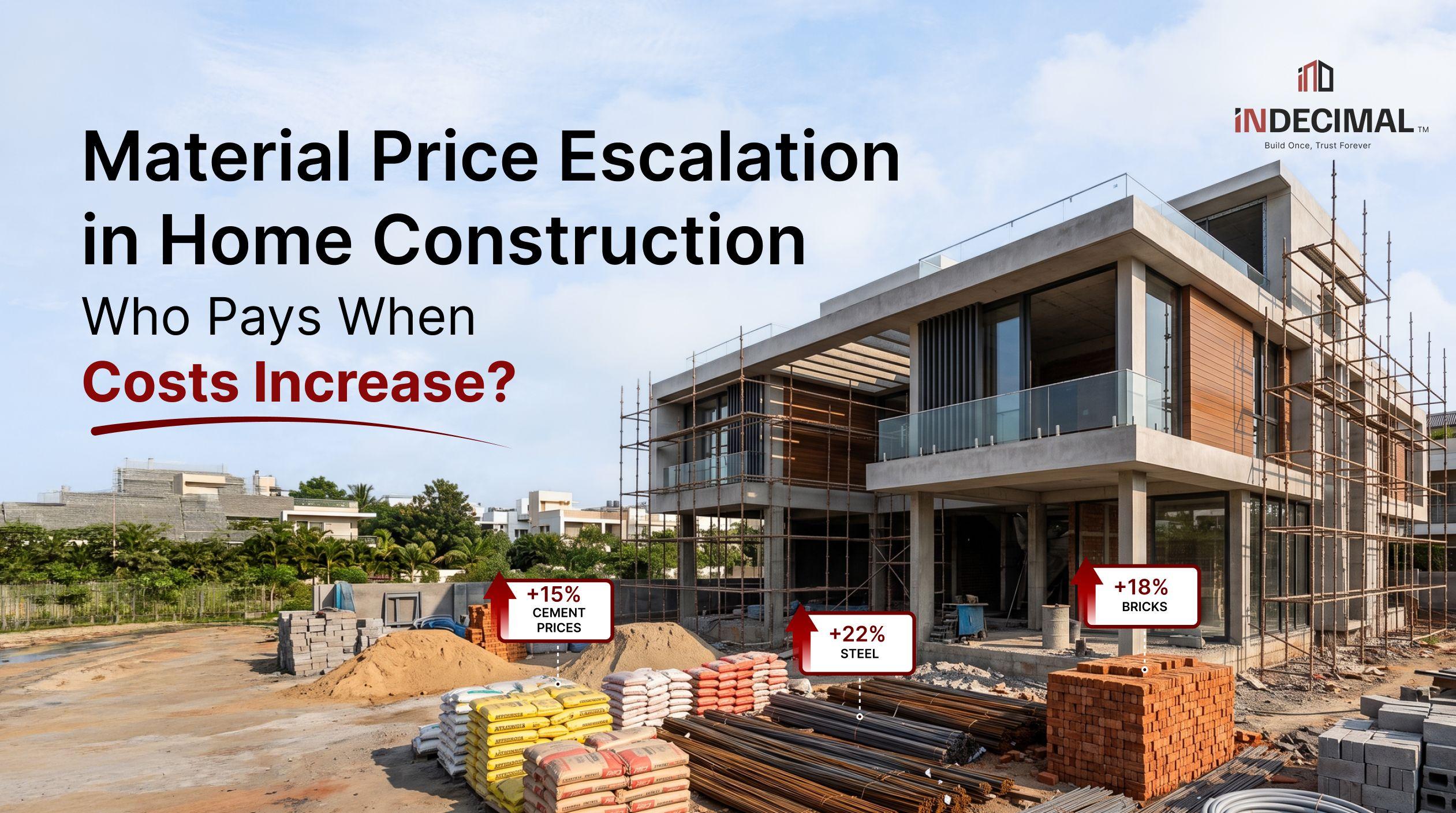
Steel and cement prices in India have moved by 15 to 30 percent within a single construction cycle more than once in the last decade. When that happens mid-project, someone absorbs the difference between what the contract assumed and what materials actually cost on the day they're purchased. Whether that someone is you or your contractor depends entirely on a clause most plot owners never read closely until prices have already moved.
This is a plain explanation of material price escalation in home construction: what causes it, how contracts allocate the risk, and what to check before signing so you know, in advance, who pays if steel or cement prices spike halfway through your build.
What Material Price Escalation Actually Means
Escalation refers to the increase in cost of construction materials, primarily steel, cement, and sometimes finishing materials like tiles or sanitaryware, between the time a contract is signed and the time the material is actually purchased and used. Construction projects run for months, sometimes over a year, and material markets move independently of any individual project's timeline. A contract that doesn't address this explicitly leaves the question of who absorbs that movement to be argued about later, usually mid-project, which is the worst possible time to have that argument.
Why Material Prices Move During a Project
Steel and cement prices in India are driven by input costs (iron ore, coal, energy), import duties, seasonal demand cycles, and broader macroeconomic conditions, none of which have any relationship to your specific project's timeline. A six-month gap between signing a contract and pouring a foundation slab is enough time for steel prices alone to move by a meaningful percentage in either direction. This is a structural feature of the construction market, not a sign that something has gone wrong with your project specifically.
Who Pays: It Depends Entirely on the Contract Type
This connects directly to the distinction between an estimate and a fixed price contract. In a genuine fixed price contract with no escalation clause, the contractor bears the full risk of material price movement, since the agreed price doesn't change regardless of what materials actually cost. In a cost-plus contract, the client bears the full risk, since the client is billed for actual material costs as incurred. Most real-world contracts sit somewhere between these two extremes, using an escalation clause to split the risk according to specific, pre-agreed terms.
| Contract Structure | Who Bears Material Price Risk |
|---|---|
| Fixed price, no escalation clause | Contractor absorbs the full movement |
| Fixed price with escalation clause | Shared, per the clause's formula and cap |
| Cost-plus | Client absorbs the full movement |
| GMP with escalation carve-out | Contractor absorbs it up to the ceiling; specified materials may be carved out |
How an Escalation Clause Actually Works
A well-drafted escalation clause typically includes four components, and checking for all four is what separates a fair clause from a one-sided one.
1. A Defined Reference Price and Date
The clause should state the material rate assumed at the time of contracting, ideally referencing a specific date and source (a published market rate or a specific supplier quote), so any later escalation is measured against a fixed, verifiable baseline rather than a vague "current rate."
2. A Trigger Threshold
Many escalation clauses only activate once price movement crosses a defined threshold, commonly 5 to 10 percent, rather than adjusting for every minor fluctuation. This protects both parties from renegotiating the contract over routine market noise.
3. A Cap (Ceiling) on Escalation Pass-Through
A fair clause caps how much of the increase gets passed to the client, whether as a percentage of the total contract value or as an absolute cap on the escalation itself. An uncapped escalation clause defeats much of the purpose of agreeing to a fixed price in the first place, since it reintroduces open-ended risk through the back door.
4. A Verification Mechanism
The clause should specify how escalation is verified, typically against a published index (such as steel and cement price indices tracked by industry bodies) or supplier invoices, rather than left to the contractor's unverified claim. Without a verification mechanism, "prices went up" becomes an assertion you have no practical way to check.
A Simple Example
Suppose a contract fixes the steel rate at Rs 62 per kg at signing, with an escalation clause triggering only above a 7 percent movement, capped at 50 percent of any increase being passed to the client, verified against a named steel price index. If steel later rises to Rs 70 per kg, a 12.9 percent increase, the clause activates (since it crossed the 7 percent threshold), and the client absorbs half of the increase above the threshold, verified against the named index, while the contractor absorbs the rest. Without this structure in place, the same price movement could result in the contractor asking for the full difference informally, with no formula, no cap, and no independent way to verify the claim.
What a Fair Escalation Clause Looks Like vs a One-Sided One
A fair clause is bidirectional: it accounts for price decreases as well as increases, passing savings back to the client if material prices fall, not just passing increases through. A one-sided clause that only ever adjusts upward is a signal worth negotiating before signing.
A fair clause names specific materials (typically just steel and cement, the two most volatile major inputs) rather than vaguely covering "all materials," which would expose the client to price movement on items that should reasonably be the contractor's risk to manage, like finishing materials sourced well in advance.
A fair clause ties escalation to a verifiable index or documented invoice, not the contractor's word alone.
Red Flags in Escalation Terms
No escalation clause at all in a fixed price contract signed months before construction is expected to begin, which usually means the contractor has either built a large buffer into the price already, or is planning to raise the issue informally later.
An escalation clause covering all materials broadly, rather than the specific volatile inputs (steel and cement) that genuinely warrant one.
No cap on how much of an increase gets passed through, leaving the client exposed to the same open-ended risk a fixed price contract was meant to remove.
No defined reference price or verification method, making any future escalation claim impossible to check independently.
An escalation clause that only works in one direction, adjusting for increases but never accounting for price decreases.
How to Protect Yourself Before Signing
Ask directly whether the fixed price includes an escalation clause, and if so, request the reference price, threshold, cap, and verification method in writing, not as a verbal explanation. If the contract has no escalation clause, confirm explicitly that the contractor is accepting full material price risk at the quoted price, since some contractors assume this is understood while actually planning to raise the issue if prices move significantly. Getting this in writing before signing removes the ambiguity that turns into a dispute later.
Frequently Asked Questions
Is an escalation clause standard in Bangalore construction contracts? It varies. Some contractors build a buffer into their fixed price and skip the clause entirely; others include one, particularly for longer projects (8 months or more) where material price movement over the timeline is a genuine risk worth addressing explicitly.
Should I ever agree to an uncapped escalation clause? Generally, no. An uncapped clause removes the budget certainty that a fixed price contract is meant to provide. If a contractor insists on one, ask for at least a percentage cap tied to total contract value.
Does escalation apply to labor costs too, or just materials? Most escalation clauses focus specifically on volatile materials like steel and cement. Labor cost escalation is less commonly addressed in residential contracts but can be relevant on longer commercial projects.
What index should material price escalation be verified against? Common references include published steel and cement price bulletins from industry associations, or documented supplier invoices from the specific period in question. The key is agreeing on a source in the contract itself, not after a dispute arises.
Can I negotiate an escalation clause after signing the contract? It's far harder once signed. This is a term to negotiate and finalize before signing, precisely because negotiating it after prices have already moved puts both parties in an adversarial position with no pre-agreed framework to fall back on.
Where This Leaves You
Material price escalation isn't a risk you can eliminate. It's a risk you can allocate clearly, in writing, before it becomes a live issue mid-project. A fixed price contract that's silent on escalation isn't necessarily a bad deal, but it is an undefined one, and undefined risk allocation is exactly what turns a routine market movement into a contract dispute.
If you're finalizing a construction contract in Bangalore and want the escalation terms reviewed before you sign, Indecimal will walk through the clause with you, reference price, cap, and verification method included, so you know exactly what happens if steel or cement prices move.
Worried About Rising Material Costs Mid-Project?
We'll review your escalation clause, cap, and verification terms before you sign.