
 Brochure

PG Construction in Bangalore Can Make You Earn 2.5lacs/month - Most Plot Owners Build the Wrong Thing
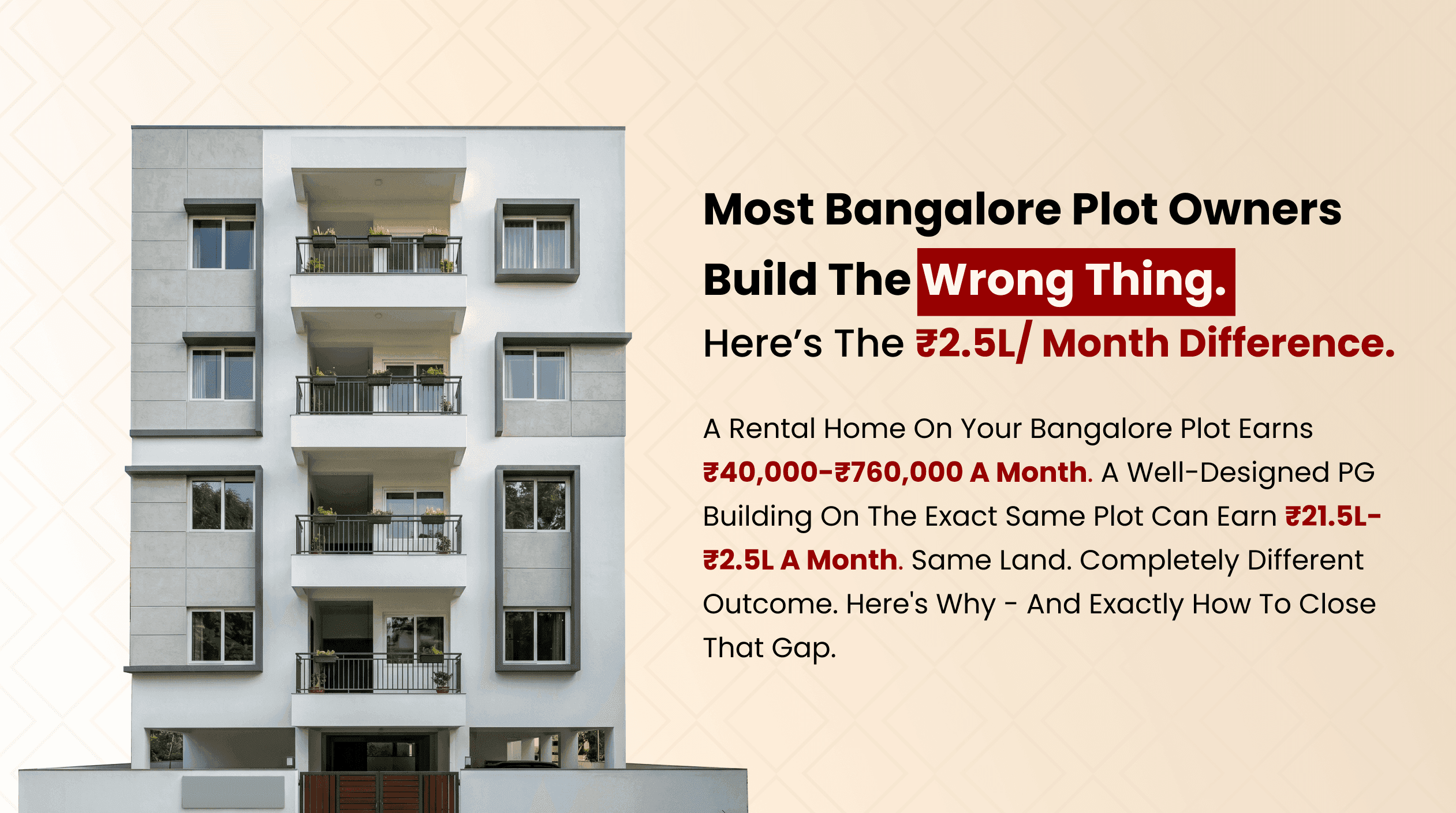
You own a plot in Bangalore. You want to generate rental income from it. So you do what most people do, you build a house. A proper 3BHK or 4BHK house, maybe a G+2. You find a family tenant. They pay ₹35,000 a month. You feel like you've made a smart investment.
But here's the question nobody asks you: Was a rental home really the best use of that plot?
Probably not.
Bangalore is one of the most under-served PG and co-living markets in India. Every year, 3–4 lakh people migrate to the city for IT jobs, startup careers, medical work, and education. The vast majority of them are single professionals and students between 22 and 35 years old. They don't want a 3BHK. They want a clean, well-managed single room in a decent locality and they're willing to pay ₹12,000–₹18,000 per month for it.
If your plot can fit 15 such rooms instead of one 3BHK, the math changes dramatically. And the difference is not marginal. It's 3X to 5X more monthly income from the same land.
Same plot. Different buildings. 3X income. The only thing that changed was the decision made before breaking ground.
The tragedy is that most plot owners only discover this after they've already built the wrong thing. This guide exists so you don't make that mistake.
The Income Gap: ₹50,000/Month vs ₹2.5 Lakh/Month, Same Plot
Before we talk about design, strategy, or construction, let's look at the numbers that drive this entire decision. Because once you see the gap clearly, everything else will make more sense.
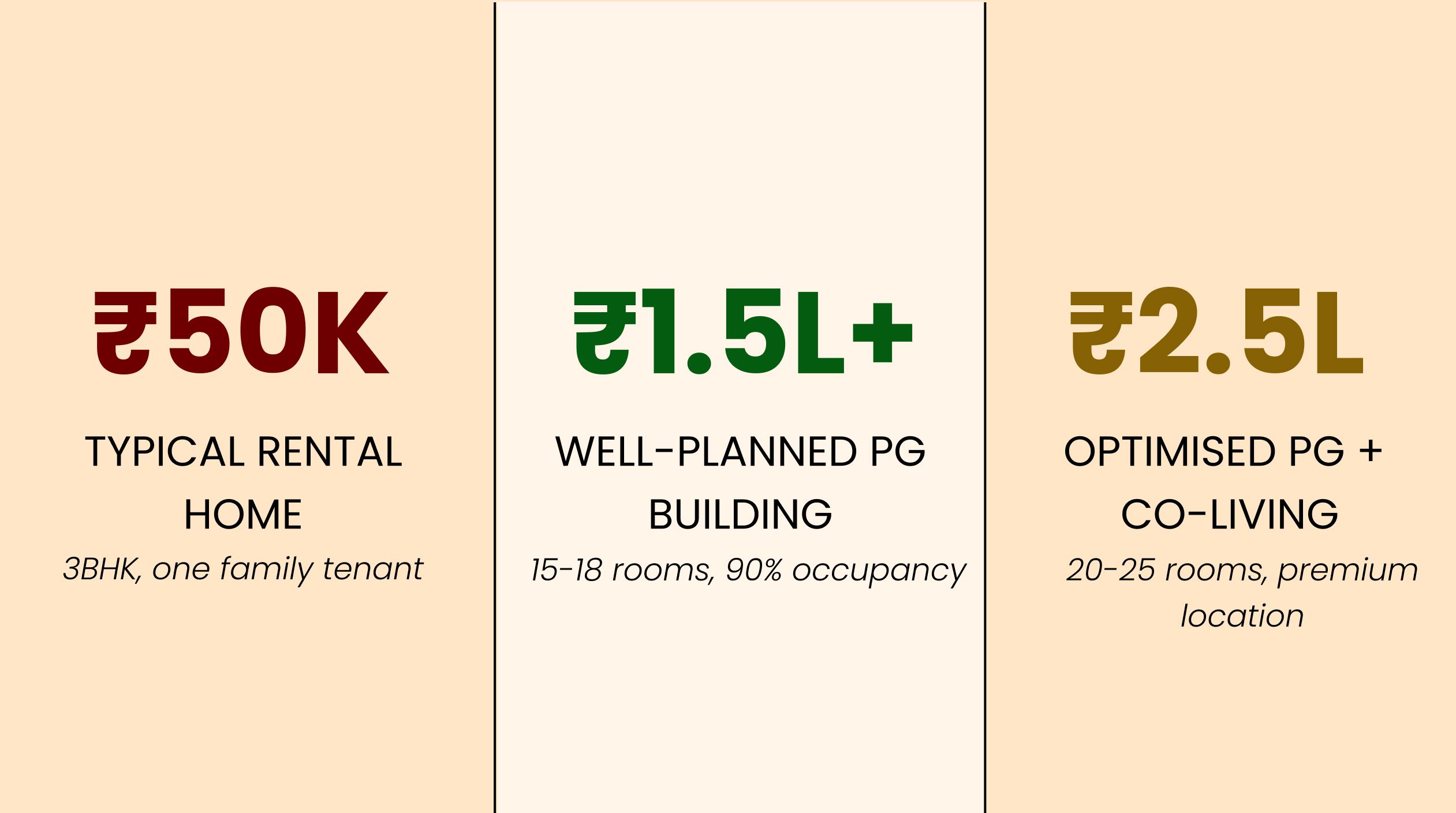
Let's make this concrete. Consider a 30×40 plot in Whitefield, near the tech corridor. A typical rental home on this plot earns ₹40,000–₹60,000 per month from a single family. Property tax, maintenance, vacancies, and brokerage reduce net yield to under 4% annually.
The same 30×40 plot, built as a purpose-designed PG building with G+3 floors, 18–20 rooms with smart room mix can generate between ₹1.5 lakh and ₹2 lakh per month at 85–90% occupancy. Net ROI: 18–25% annually. That's not a forecast. That's what well-managed PG properties near tech corridors in Bangalore are actually delivering.
| METRIC | TYPICAL RENTAL HOME | PLANNED PG BUILDING |
|---|---|---|
| Monthly income | ₹40,000–₹60,000 | ₹1,50,000–₹2,50,000 |
| Number of paying units | 1 family | 16–22 rooms |
| Vacancy risk | One vacancy = zero income | One vacancy = minor dip |
| Annual ROI | 3–5% | 18–28% |
| Tenant demand | Narrow (families only) | Broad (students, professionals, couples) |
| Occupancy rate | 75–85% (one vacancy = 0%) | 85–92% with room mix |
| Income stability | Vulnerable — one tenant leaves, income drops to zero | Distributed — one vacancy is 5% revenue drop |
| 10-Year Total | ~₹48–72 Lakhs | ~₹1.8–3 Crore |
The 10-year income difference between these two choices is ₹1 crore to ₹2 crore on the same plot. The construction cost difference is far smaller, typically ₹15–25 lakhs more to build a purpose-designed PG vs a standard rental house. The ROI on that additional investment is, in most cases, recovered within 18–30 months.
The risk of PG construction is not financial, the ROI is well-established in Bangalore's market. The actual risk is design risk: buildings that don't target the right tenant type for their location end up with 60% occupancy and low rental per room. The solution is not to avoid building a PG. It's to build it correctly.
Where the 60% Occupancy Problem Begins, It's Not Location
Most Bangalore PG buildings run at 60–65% occupancy. Owners blame location. They say the area isn't popular enough, or the competition is too high, or the market is saturated. But that's rarely the real reason.
The real reason most PG buildings underperform is simpler and more painful: they are designed like houses, not like rental businesses.
Most rental buildings start losing money before the first tenant moves in. Because the mistake happens at the design stage.
Here's what typically happens. A plot owner decides to build a PG. They hire an architect who has designed residential homes their entire career. That architect draws up a floor plan based on familiar principles, living rooms, dining areas, large bathrooms, 2BHK and 3BHK unit configurations. The building gets constructed. And then the owner discovers that nobody in their target market, young IT professionals and students, actually wants a 2BHK unit in a PG building.
They wanted:
- A clean single room with an attached bathroom
- Proximity to a metro station or their office
- WiFi and a small pantry
They didn't want:
- A full kitchen
- A separate living room
So the rooms sit empty. And the owner reduces the rent to attract anyone. And the building stabilises at 60% occupancy at ₹8,000 per room, far below what it could have earned.
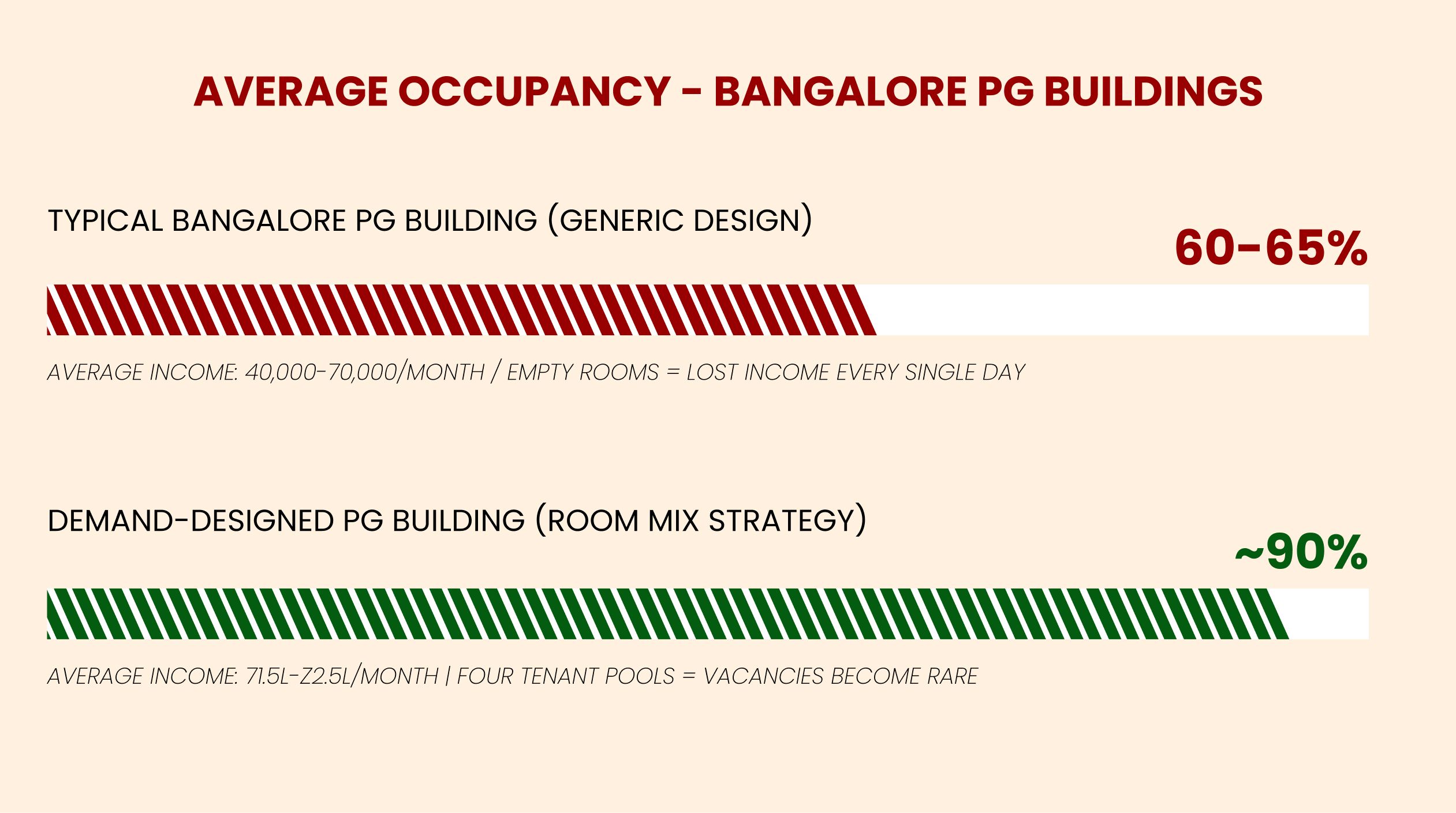
The 30% occupancy gap between a generic building and a demand-designed building is entirely explained by one thing: whether the building was designed by an architect or designed by occupancy data.
Most Bangalore buildings are designed by architects. Indecimal's commercial buildings are designed by occupancy data. That's the core difference and it shows up every month on the rental income statement.
The Room Mix Strategy: How to Design for 90% Occupancy
The single most important concept in PG building construction in Bangalore is room mix. Understanding this concept and applying it correctly is the difference between a building that earns ₹60,000 a month and one that earns ₹1.8 lakh a month.
The idea is straightforward: different tenant profiles want different room types. A building that offers only one room type can attract only one tenant profile. The moment that profile goes away, say a company relocates or a college intake drops, occupancy collapses.
A building designed with a smart room mix attracts four different tenant pools simultaneously. When one pool weakens, the others absorb the slack. This is what makes vacancies rare instead of constant.
The Four Tenant Pools in Bangalore PG Buildings
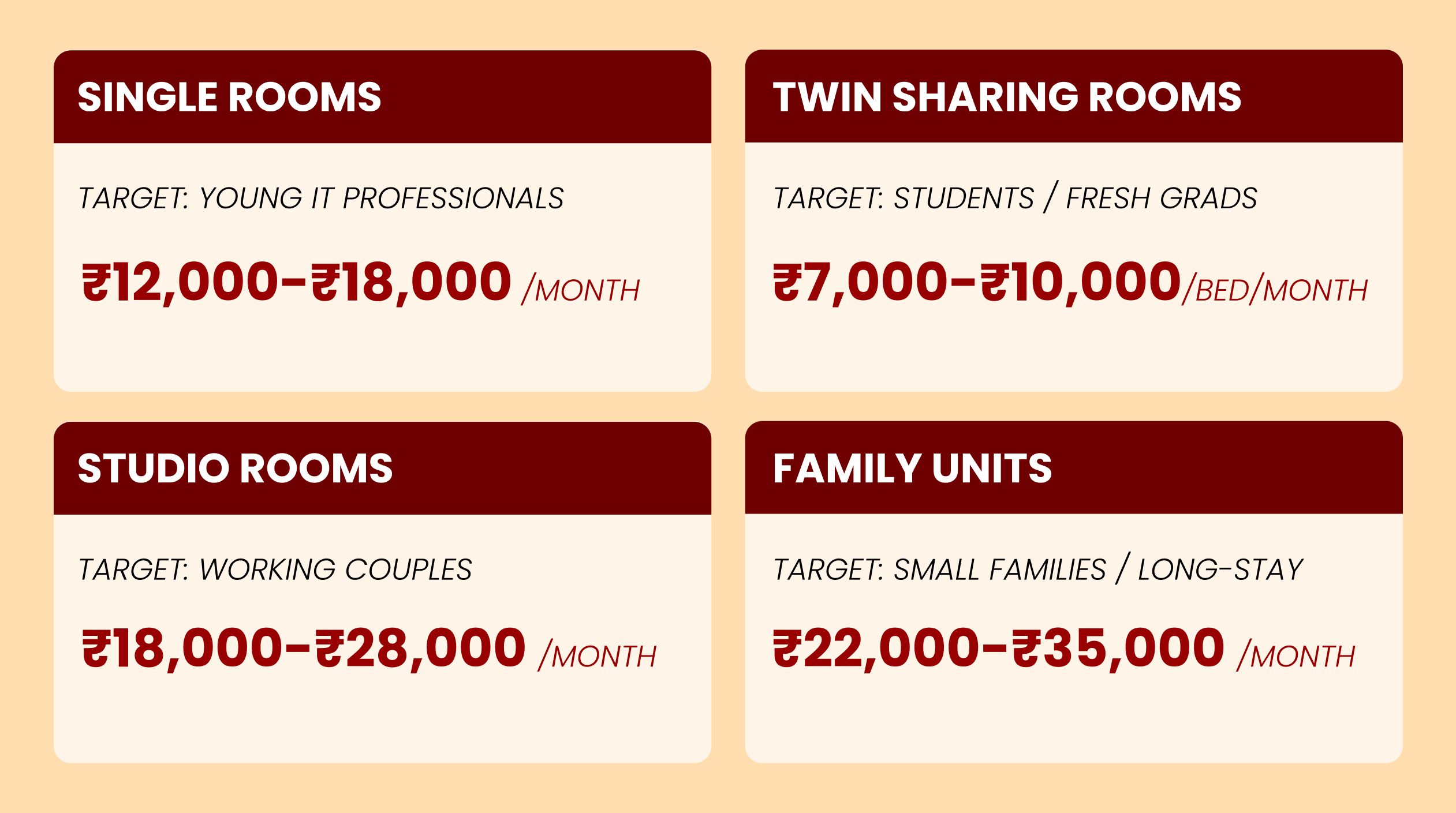
The proportions of each room type in your building are not fixed, they depend entirely on where your plot is located and what kind of demand exists in that specific micro-market. A building near Electronic City needs a heavy tilt toward single rooms and twin-sharing rooms for IT professionals. A building near a hospital corridor needs studio rooms for junior doctors and family units for senior medical staff.
The mistake most builders make is applying the same floor plan regardless of location. A generic 2BHK-heavy layout near a college is a guaranteed low-occupancy building. A single-room-heavy layout in a corporate corridor near Outer Ring Road, on the other hand, will run at 92% occupancy with a waiting list.
One building. Four tenant pools. Vacancies become rare. When you serve young professionals, students, working couples, and small families simultaneously, no single shift in demand can significantly hurt your occupancy. This is the fundamental risk management principle of PG building design in Bangalore.
How the Math Works: One Building, Four Tenant Pools
Let's take a real example. A G+3 building on a 30×40 plot in a tech corridor area near Sarjapur Road. 22 units total:
- 8 single rooms @ ₹15,000/month = ₹1,20,000
- 6 twin-sharing rooms @ ₹8,500/bed × 2 beds = ₹1,02,000
- 5 studio rooms @ ₹22,000/month = ₹1,10,000
- 3 family units @ ₹30,000/month = ₹90,000
Total potential monthly income at 100% occupancy: ₹4,22,000
At 90% occupancy (which a demand-designed building achieves routinely), that's ₹3,80,000 per month. Even at 75%, a conservative scenario, that's ₹3,16,500 per month. Versus ₹50,000 from a rental home on the same land.
After operator management fees (typically 10–15%), maintenance, property tax, and loan EMI (if applicable), the net monthly income in a well-managed building of this type in Bangalore is typically ₹1.8 lakh to ₹2.5 lakh. That's the number in Indecimal's carousel, and it's not a marketing claim, it's what the math actually produces.
Which Bangalore Locations Need Which Building Type
The single most important design input for any PG building in Bangalore is the demand analysis for that specific location. Not just the general area, the specific street, the nearest employment cluster, the educational institutions within 2km, the transit connectivity. All of these factors determine what room types will achieve the highest occupancy at the highest rents.
Here is a practical breakdown of how Bangalore's major corridors map to tenant demand:
| BANGALORE LOCATION | PRIMARY TENANT | RECOMMENDED ROOM MIX | EXPECTED RENT/ROOM |
|---|---|---|---|
| Whitefield / ITPL | IT Professionals | 60% single, 30% twin, 10% studio | ₹14,000–₹20,000 |
| Electronic City | IT / Fresher workforce | 40% single, 50% twin, 10% studio | ₹10,000–₹16,000 |
| Sarjapur Road / ORR | Mid-senior IT professionals | 50% single, 20% twin, 30% studio | ₹16,000–₹25,000 |
| Koramangala / HSR | Startup workforce, professionals | 50% single, 20% twin, 30% studio | ₹18,000–₹28,000 |
| Near Colleges (Hebbal, Yelahanka) | Students, fresh graduates | 20% single, 70% twin, 10% family | ₹7,000–₹12,000 |
| Near Hospitals (Jayanagar, JP Nagar) | Medical staff, doctors | 40% single, 20% twin, 30% studio, 10% family | ₹14,000–₹24,000 |
| North Bangalore (Devanahalli, Airport area) | Aviation, logistics, families | 30% single, 20% twin, 20% studio, 30% family | ₹12,000–₹20,000 |
This is not a standard table you find in a textbook. This is based on actual rental market data from Bangalore's micro-markets and the occupancy patterns Indecimal has observed across projects. The point is this: the same building design does not work everywhere. What achieves 90% occupancy in Whitefield will achieve 60% in a college corridor. The design must follow the demand data, not the other way around.
Most plot owners decide to build a PG, then hire a contractor who builds the same floor plan they've built 20 times before. No demand analysis. No tenant profiling. No location-specific room mix. This is why the average Bangalore PG building runs at 60% occupancy. The mistake is not that they built a PG, the mistake is that they didn't build the right PG for their location.
What a Well-Designed PG Building in Bangalore Actually Looks Like
Beyond room mix, there are specific design principles that separate high-occupancy PG buildings from mediocre ones in Bangalore. These are not about aesthetics, they're about function. Every design decision in a commercial rental building should answer one question: does this increase occupancy or rental yield?
Structural and Layout Principles
1. MAXIMISE RENTABLE FLOOR SPACE
In a residential home, common areas like living rooms and dining spaces are necessary. In a PG building, every square foot of common area is a square foot that's not earning rent. Well-designed PG buildings minimise non-revenue spaces while maintaining livability, compact lobbies, efficiently designed corridors, shared kitchenettes rather than full kitchens per room. The goal is maximum rentable rooms within BBMP floor area regulations.
2. ATTACHED BATHROOMS ON EVERY ROOM
This is non-negotiable for premium PG buildings in Bangalore today. The market has moved decisively, shared bathrooms are a deal-breaker for IT professionals earning ₹40,000+ per month. Attached bathrooms justify 30–40% higher rents and dramatically improve occupancy. The construction cost difference is ₹80,000–₹1,20,000 per bathroom unit. The rental premium more than covers it within 8–12 months.
3. INDEPENDENT AC POINTS FOR EACH ROOM
For PG buildings targeting IT professionals in Bangalore, Whitefield, Sarjapur, ORR, Electronic City, AC is no longer a premium feature. It's the baseline. Buildings without AC provision earn ₹2,000–₹4,000 less per room per month and struggle to maintain occupancy above 70%. Plan AC points during construction rather than retrofitting, which costs significantly more and creates maintenance complexity.
4. NATURAL LIGHT AND VENTILATION IN EVERY ROOM
One of the most common design failures in PG buildings is interior rooms with no natural light or ventilation, typically rooms fitted in the center of a floor plate to maximise room count. These rooms rent for 20–35% less than rooms with windows, and they have significantly higher vacancy rates. Good PG building design avoids central interior rooms entirely or treats them as storage/utility spaces.
5. TERRACE, COMMON AREAS, AND TENANT AMENITIES
A well-designed terrace area, a small gym space, or a clean common pantry area adds ₹1,000–₹2,000 to the rental premium per room and significantly improves retention. Tenants stay longer when there are spaces to unwind. Retention matters more than you think: every tenant who stays 18 months instead of 9 months saves you one month's brokerage and one month's vacancy.
6. BUILDING MANAGEMENT INFRASTRUCTURE
Plan for technology from day one: CCTV placements, wifi router infrastructure, intercom systems, digital lock compatibility, and solar water heating systems. These are far easier and cheaper to design in during construction than to retrofit. Buildings with good tech infrastructure command higher rents from the segment of tenants, young IT professionals, who are the highest-paying and most reliable tenant type in Bangalore's PG market.
Every design decision should pass one test: does this increase occupancy, increase rent per room, or increase tenant retention? If a design feature does none of these three things, it belongs in a residential home, not a commercial rental asset.
PG Building Construction Cost in Bangalore: Realistic Numbers for 2025
One of the biggest information gaps for plot owners considering PG construction in Bangalore is accurate cost data. Most estimates found online are either outdated, dramatically underquoted to generate leads, or vaguely general to the point of uselessness. Here is a realistic breakdown.
Construction Cost Per Square Foot (2025)
PG building construction in Bangalore falls within the commercial construction category. The cost depends on the number of floors, the finishing specifications, the room configuration, and the building's overall area. The broad range for a well-built, mid-premium PG building in Bangalore in 2025:
| BUILDING TYPE | CONSTRUCTION COST | NOTES |
|---|---|---|
| Basic PG (shared bathrooms, no AC points) | ₹1,400–₹1,700/sqft | Not recommended — poor ROI ceiling |
| Mid-Premium PG (attached bathrooms, AC points) | ₹1,800–₹2,200/sqft | Best ROI bracket for most Bangalore locations |
| Premium Co-Living (studio + amenity areas) | ₹2,200–₹2,700/sqft | For Koramangala, HSR, Whitefield premium zones |
Total Project Cost Estimate: For 30×40 Plot, G+3 Building
Let's work through a realistic example. A 30×40 plot (1,200 sqft) in the Whitefield area. G+3 construction (ground + 3 floors = 4 floors total). Each floor approximately 900–1,000 sqft of usable built area. Total built-up area: approximately 3,800–4,000 sqft.
| COST HEAD | ESTIMATE | NOTES |
|---|---|---|
| Construction cost (₹2,000/sqft × 3,800 sqft) | ₹76,00,000 | Mid-premium specification |
| BBMP plan approvals + legal | ₹3,00,000–₹5,00,000 | Varies by plot and zone |
| Electrical + plumbing fit-out | Included in above | Part of construction cost |
| Water sump, lift (optional) | ₹3,00,000–₹6,00,000 | Lift strongly recommended for G+3 |
| Furniture (beds, wardrobes, study tables) | ₹1,50,000–₹2,00,000 | For 20 rooms @ ₹7,500–₹10,000/room |
| Interiors, paint, common areas | ₹3,00,000–₹5,00,000 | For common areas and corridor finishing |
| Total Project Cost | ₹86 Lakh – ₹1.04 Crore (all-in) |
At monthly income of ₹1.8L–₹2.2L, the total investment of ₹90 lakh–₹1 crore is recovered in 5–6 years of net income. From Year 7 onwards, the asset generates pure income. The land value has also appreciated independently through this period. This is why PG construction remains one of the strongest investment decisions for Bangalore plot owners in 2025.
Many contractors quote ₹1,100–₹1,400/sqft for PG construction to win the business, then add escalation charges midway. A legitimate fixed-price construction contract at ₹1,800–₹2,200/sqft is more reliable than a low quote with no protection against escalation. Always insist on a **locked, written contract with no escalation clauses.
Full ROI Calculation: Is PG Construction in Bangalore Worth It?
Let's do the full 10-year ROI calculation for PG building construction in Bangalore with realistic assumptions, not marketing projections.
| ASSUMPTION | VALUE |
|---|---|
| Total project cost (construction + furniture) | ₹95 Lakhs |
| Number of rooms | 20 rooms (mixed type) |
| Average rent per room | ₹14,000/month |
| Gross monthly income at 100% | ₹2,80,000 |
| Occupancy rate (demand-designed) | 88% |
| Gross monthly income at 88% occupancy | ₹2,46,400 |
| Annual rent escalation (typical) | 8–10% |
| Operating costs (management, maintenance, taxes) | ₹35,000–₹45,000/month |
- Net monthly income: ₹2,00,000–₹2,10,000 in Year 1
- Annual net income: ₹24 Lakhs in Year 1, growing at 8–10% per year with rent escalation
- Simple payback period: 4.8 years on the ₹95 lakh investment
- 10-year total net income: approximately ₹3.5 Crore (with 8% annual escalation)
- IRR (Internal Rate of Return): 22–26%, depending on land cost basis and financing structure
These numbers represent what a demand-designed, professionally constructed and managed PG building achieves. A generic building at 60% occupancy on the same investment earns significantly less, typically ₹12–14 lakhs annual net income in Year 1, versus ₹24 lakhs. The difference is entirely in design quality and room mix strategy.
The question is never whether to build a PG in Bangalore. The question is whether to build it the right way or waste the opportunity.
How Indecimal Builds PG Properties: The End-to-End Process
Indecimal is India's first maintenance-backed construction company and the first construction brand in Bangalore to be featured on Bharat Ke Super Founders (Amazon Prime & MX Player). Our approach to PG building construction is different from traditional contractors in one fundamental way: we design every commercial project for rental income, not aesthetics.
Here is exactly how we approach a PG building project from first conversation to first tenant cheque.
1. LAND FEASIBILITY + RENTAL DEMAND ANALYSIS
Before any design work begins, our team analyses location-specific rental demand, tenant profile data, comparable occupancy rates, and income benchmarks for your specific area of Bangalore. We produce a detailed feasibility report with projected income scenarios at different occupancy levels. This report is the foundation of every design decision that follows. If the numbers don't stack up at your location, we tell you, before you spend a rupee on construction.
2. ROOM MIX STRATEGY + ARCHITECTURAL DESIGN
Based on the demand analysis, we determine the optimal room mix for your plot and location. Our architects then design a floor plan that maximises rentable room count, incorporates the recommended room types, provides natural light to all rooms, and meets BBMP approval requirements. You receive a full 3D visualization of the building before construction begins.
3. APPROVALS + BBMP COMPLIANCE
We manage all regulatory approvals for your PG building project, BBMP plan approval, occupancy certificate, fire NOC (if required), and RERA documentation where applicable. This is one of the most time-consuming and frustrating parts of construction in Bangalore for most owners. We handle it completely, on your behalf.
4. FIXED PRICE CONSTRUCTION WITH ESCROW PROTECTION
Every Indecimal construction contract is a fixed-price agreement. What we quote on Day 1 is what you pay on completion. No escalation clauses. No material cost additions. Your payments are held in escrow and released only on verified milestone completion, you approve each stage before funds are released. And if we miss the delivery date, you receive ₹500 per day in compensation, automatically deducted from our final payment.
5. 445+ QUALITY CHECKS — DOCUMENTED, NOT PROMISED
Every Indecimal PG building project goes through 445+ documented quality checkpoints from foundation to finishing, concrete cube tests, steel placement verification, waterproofing inspection, electrical load testing, plumbing pressure tests. All results are photographed and available in real time through the Indecimal project tracking app. You're never in the dark about what's happening on site.
6. HANDOVER + RENTAL SUPPORT + 10-YEAR MAINTENANCE
After construction, we support tenant acquisition, connecting you with PG operators, property management companies, and direct tenant channels. And when we hand over your building, we don't disappear. For up to 10 years, all structural maintenance and repairs are covered at zero cost. This is what India's first maintenance-backed construction company actually means in practice.
FAQs — PG Construction in Bangalore
What is the cost of PG building construction in Bangalore?
PG building construction in Bangalore costs between ₹1,800 and ₹2,700 per square foot depending on specification in 2025. A mid-premium PG building with attached bathrooms and AC provision costs approximately ₹2,000–₹2,200 per square foot. For a typical 30×40 plot built to G+3, total project cost (all-in, including furniture and approvals) is approximately ₹86 Lakhs to ₹1.04 Crore.
How much monthly income can a PG building earn in Bangalore?
A well-designed PG building with demand-based room mix can generate ₹1.5 Lakh to ₹2.5 Lakh per month in net income. The critical variable is occupancy, demand-designed buildings achieve 85–90% occupancy versus Bangalore's typical 60–65% for generic designs. Locations near IT corridors (Whitefield, Electronic City, Sarjapur, Koramangala) deliver the highest per-room rents.
How long does PG construction take in Bangalore?
Typically 10–14 months from design sign-off to handover, depending on scale and BBMP approval timelines. Indecimal's fixed-timeline contracts include a ₹500/day delay penalty so there is financial accountability for every day beyond the committed date.
What is the ROI on PG building construction in Bangalore?
Well-planned PG buildings in Bangalore deliver 20–28% ROI annually, compared to 3–5% from a standard rental home on the same plot. Simple payback period on construction investment (excluding land) is typically 4–6 years. Total 10-year net income from a well-designed PG building on a 30×40 plot: approximately ₹2.5–₹3.5 Crore.
Does the Room Mix Strategy work for all Bangalore locations?
The room mix principle works everywhere, but the specific mix must match local demand. A college area needs heavy twin-sharing. A tech corridor needs single rooms and studio units. A hospital zone needs family units. Applying the wrong mix to a location is how buildings end up at 60% occupancy even with good construction quality. The demand analysis must come before the floor plan, not after.
How is Indecimal different from other construction companies for PG buildings in Bangalore?
Three core differences: First, we design for occupancy data, not architectural preference, every floor plan is preceded by a location-specific demand analysis. Second, every project comes with a fixed price contract with zero escalation and ₹500/day delay penalty. Third, we provide up to 10-year zero-cost maintenance after handover, something no other construction company in Bangalore currently offers. We are also the first construction brand in Bangalore featured on Bharat Ke Super Founders, Amazon Prime & MX Player.
Related Construction Guides
Does Your Bangalore Plot Qualify for High-Income PG Construction?
Not every plot is suited for every building type. We evaluate your plot size, location demand, zoning rules, and income potential, before you commit to anything. No cost. No obligation.